Introduction
The purpose of this project is to design, build, fabricate, and test an op-amp based circuit that converts a 2 Vpp at 350 Hz square wave to a 4 Vpp at 350 Hz sine wave.
The design leverages an active narrowband bandpass filter and the fundamental frequency component of the Fourier series of the input signal to filter out and amplify the sine wave.
Because an inverting op-amp circuit is used, the filtered signal is cascaded into a second inverting op-amp to keep the output signal in phase with the input.
Design Details
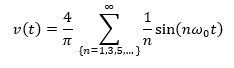
To convert the input signal to a sine wave, a Fourier series expansion of the input square signal was used:
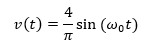
The fundamental frequency, or first harmonic, gives a sine wave of the original frequency in phase with the square wave:
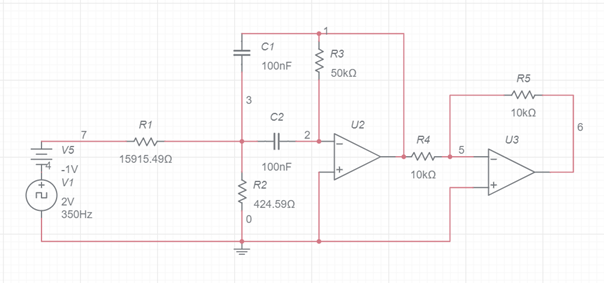
Thus, isolating the fundamental frequency results in a sine wave. To do this, an active narrowband bandpass filter was used with a center frequency of 350 Hz.
After deriving the transfer function, the gain K_0, bandwidth β, and center frequency ω_0 can be determined:
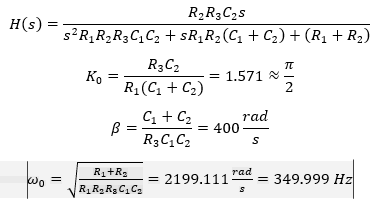
The resistor and capacitor values create a bandpass filter centered at 350 Hz with a gain of 2 and a narrow passband of 400 rad/s.
After the filter, a second inverting amplifier with a gain of 1 is cascaded to produce a non-inverted output.
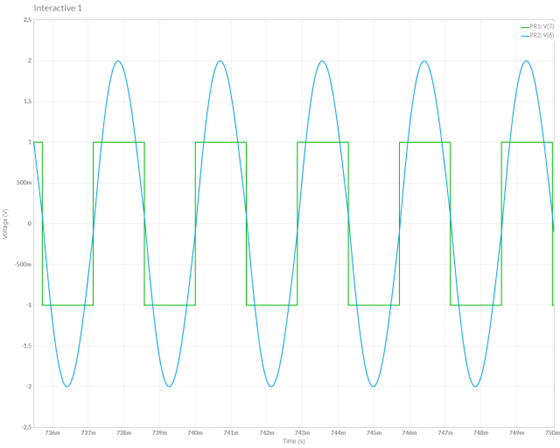
The circuit was simulated in Multisim, showing a 2 Vpp 350 Hz square wave input converted to a 4 Vpp 350 Hz sine wave:
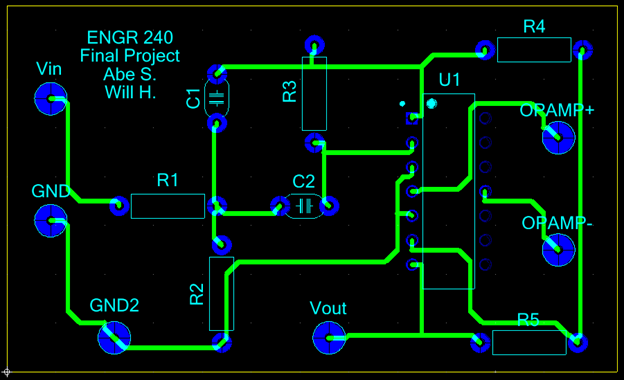
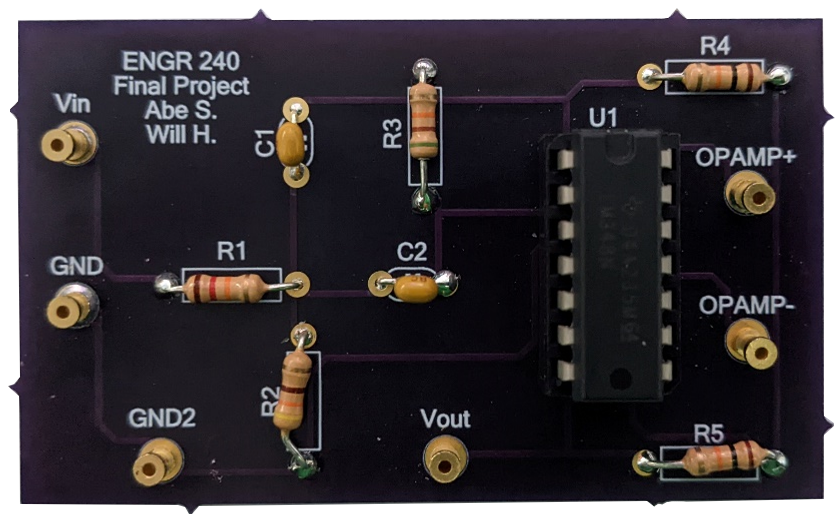
After simulating, the circuit was transferred to a PCB layout in Ultiboard and sent to be fabricated.
The LM348 from Texas Instruments was chosen for its convenience of multiple op-amps on one IC.
Results and Discussion
Upon receiving and populating the PCB, the circuit was tested with the input 2 Vpp 350 Hz square wave, expecting a 4 Vpp 350 Hz sine wave in phase with the square wave at Vout.
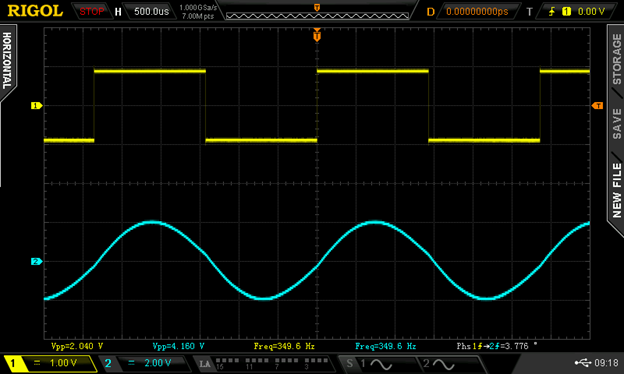
The output comes out as a 4.16 Vpp at 349.6 Hz sine wave with a 3.776° phase shift from the input square wave — within the appropriate error margin for component tolerances.
Conclusion
The circuit fulfilled the purpose of this project. Improvements could be made using higher quality components, a smaller PCB layout, and a chip with only two op-amps rather than four.